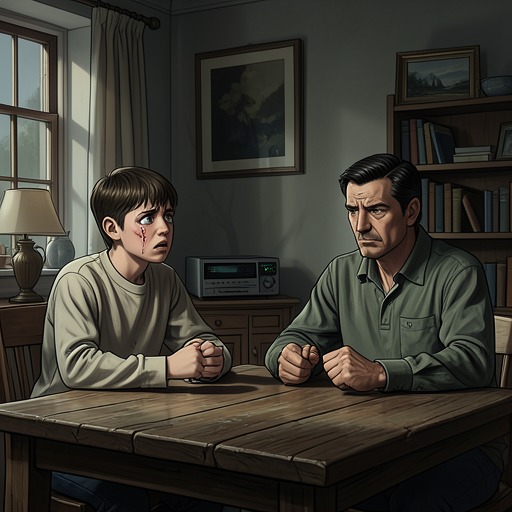
Intergenerational Trauma and PTSD
The GuiltyIntergenerational Trauma and PTSD is a family pattern traced through the lives of Adam Robie, Dan Robie, and Will Robie, rather than a claim that trauma passes unchanged from one generation to the next. The novel links the silences and injuries left by war to behavior within the Robie household, then sets that history beside Will’s present crisis after a fatal mission error. Its central distinction is between being changed by trauma and choosing, however imperfectly understood, whether to pass its harm on.
War and Adam Robie’s Return
Adam Robie’s experience of World War II supplies the family history behind Dan Robie’s account. He served in the Pacific, fighting at Guadalcanal, Kwajalein, Guam, Iwo Jima, and Okinawa. His company suffered a seventy-percent mortality rate, and he received numerous military medals. Yet the honors do not describe how he came home: he put the medals away and did not speak about the war. The novel places this silence alongside the scale of what he had witnessed and done, showing a gap between public recognition of service and the private consequences of combat.
Before the war, Adam had wanted to play baseball for the St. Louis Cardinals and marry his childhood sweetheart. Those plans did not survive. She married someone else, and Adam returned to marry another woman, with whom he had Dan. The account makes his changed life concrete without suggesting that war was the only cause of every later choice. What Dan identifies is that the man who came home was no longer simply the farm boy who had left.
Dan explains that PTSD was not yet a term used for men returning from World War II, and that soldiers were expected to resume civilian life as if the war could be set aside. Adam’s suffering instead entered family life as conduct. Dan remembers that his father seemed to regard him as an enemy, repeatedly attacking him with words and physical force, and playing cruel mind games. On one occasion, Adam called him by a Japanese name, as if reliving the war. Dan’s account connects that episode to trauma, but does not turn the connection into an excuse: he describes the harm he experienced plainly, and later acknowledges that his own behavior toward Will continued part of the pattern.
Dan Robie’s Inheritance and Repetition
At seventeen, Dan left home, describing his departure as a retreat from a father who could no longer reach him in the same way. He later joined the United States Marine Corps during the Vietnam War, despite having grown up under the effects of his father’s combat experience. Dan says he wanted to show Adam that a person could fight a war and not return as Adam had. The attempt was shaped by an incomplete understanding of trauma: Dan hoped to disprove what he had witnessed, but he could not make himself immune to war’s effects.
Dan also describes a different homecoming from Adam’s. Men returning from Vietnam did not receive the welcome given to World War II veterans; he recalls an atmosphere of hostility, disgust, or indifference. He and Jessica Reel note that PTSD was still poorly understood after Vietnam. In Dan’s account, successive generations thus encounter not only combat but also inadequate language and social recognition for what combat does. The surrounding culture asks veterans to carry on, while the family is left to live with consequences that have not been explained or resolved.
The most painful link between Adam and Dan is not simply that Dan was wounded by his father, but that he later recognized himself repeating harm he had meant to reject. He tells Will that, while mistreating him, he could picture Adam doing the same to him. One part of him believed he would never treat his own son that way; another part went on doing it. Dan acknowledges that Adam’s treatment of him was worse, but explicitly refuses to use that comparison to minimize what Will endured. The family pattern is therefore shown as repetition under pressure, not an inevitable or morally neutral inheritance.
Dan also offers a personal explanation for the way he treated Will. Will had been a popular student, a sports star, and someone who helped others without acting superior. Dan says he had reason to be proud, and that part of him was proud. Another part, he admits, may have been jealous: Will seemed to have the life Dan had wanted and never had. Dan believes he helped ruin that life and damaged the possibility of their being a family. He does not present this as a clinical analysis; he admits that he cannot fully explain himself. His account nevertheless makes the consequences specific: resentment and unresolved loss became part of his conduct toward his son.
Will Robie’s Mission Crisis
Will’s experience gives the theme a present-tense counterpart, though the novel does not diagnose him with PTSD. On a mission, he kills a little girl. The fact that the death was unintentional does not lessen his recognition that she is dead, and he wants to know how it happened. A communication identifies the child as the target’s daughter and classifies her death as collateral damage, an official description that does not answer Will’s personal question about his responsibility. He remembers that he had once come close to killing a child but had not fired; that earlier incident had nearly cost him his career. This time, he had pulled the trigger.
The immediate consequence is a collapse in the certainty on which his work depends. Will fixates on the child’s death, becomes physically ill, and looks at the callused finger formed by years of practice. He considers whether this is the point at which he must leave the work. The novel presents his distress not as a detached procedural setback but as a conflict between his professional demand for precision and his knowledge that a child died through his action.
Later, Will stands on the Arlington Memorial Bridge and recognizes that he had seen a child where no child was present. He understands that he had apparently hallucinated during a mission, which he had never experienced before. He also recognizes a disturbing transformation in the image: his mind had taken Sasha, changed her gender, moved her far away, and given her another father. The mission error therefore unsettles more than his memory of one shot. It makes him question whether his perception can be trusted in the circumstances where other people’s lives depend on it.
Will has been placed on leave and cannot return to field work unless he can resolve what has happened, if he ever can. His hands tremble as he considers that his mind has deceived him; the immediate danger is also a crisis of self-reliance. He had assumed he could depend on his own judgment, but can no longer be certain that the failure will not recur. This arc resembles the older Robies’ experience in its confrontation with lasting change, but its causes and symptoms are not presented as identical to theirs.
Confession, Responsibility, and the Possibility of Change
The family history becomes explicit when Will tells Dan about his recent missions. He says he was expected to be perfect at a complex job, but was not: he killed someone he should not have, then saw a father and boy who were not there. Speaking to Dan, Will cannot smoothly deliver the explanation he had rehearsed. The confession matters because it exposes vulnerability between men whose relationship has long been shaped by estrangement, rather than because it resolves Will’s crisis.
Dan’s response is to tell Will about Adam and to connect that account to his own failures as a father. He admits that war changes the people who fight it, and that he had been both the child harmed by Adam and the adult who harmed Will. He also describes himself as weak for failing to resist the pattern. The account gives context to the family’s violence without erasing individual responsibility: Dan’s history helps explain his conduct, but he still names what he did and the years it cost them.
The occasion for Dan’s disclosure is Will’s return to help him, despite the risk, and Will’s request for the truth. Dan recognizes that words are not enough and frames his explanation as an answer to that request. This makes the conversation a limited act of witnessing: the history that Adam had kept silent about is finally told by Dan to Will. The novel does not claim that disclosure repairs the past or cures the consequences of war. Instead, it presents truth-telling as a break in the family’s silence and a necessary distinction between understanding inherited harm and excusing it.
Narrative Significance
The three-generation structure gives the concept its shape. Adam’s unspoken wartime experience appears in the cruelty Dan remembers; Dan’s attempt to escape that past fails when he recognizes its repetition in his own parenting; Will, in turn, faces a crisis tied to his own work and a death he cannot reduce to an official classification. These are connected by consequences and by family testimony, not treated as interchangeable diagnoses.
The novel also contrasts two forms of silence. Adam never spoke about the war, leaving Dan to learn parts of his father’s history from others. Dan eventually speaks directly to Will, naming his father’s trauma, his own conduct, and the damage between them. That telling does not undo the years lost, but it changes what can be acknowledged. Alongside Will’s difficulty trusting his own perceptions, Dan’s account makes the family’s central question not whether the past can be erased, but whether its effects can be recognized before they are passed on again.